


Concert and CD
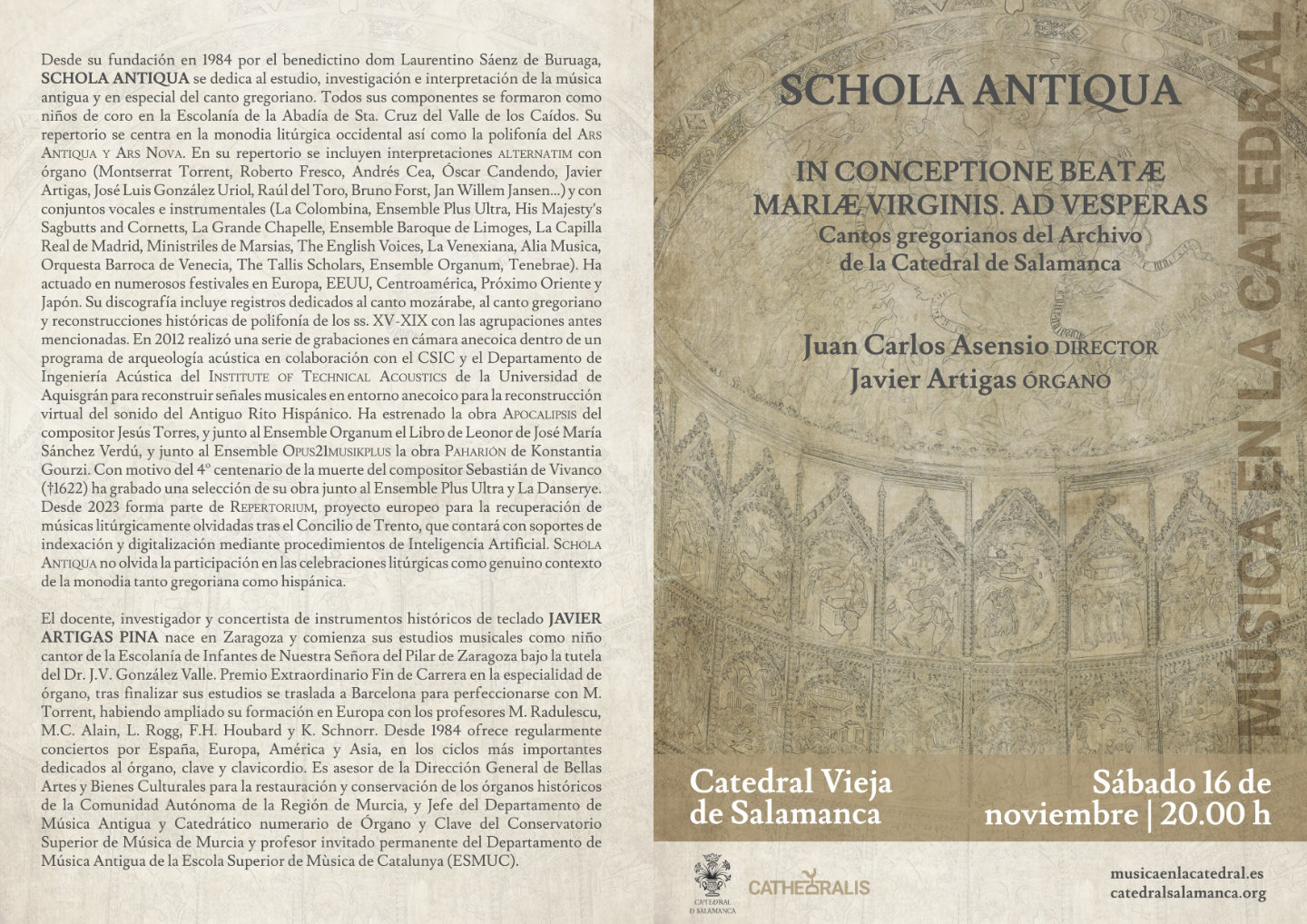
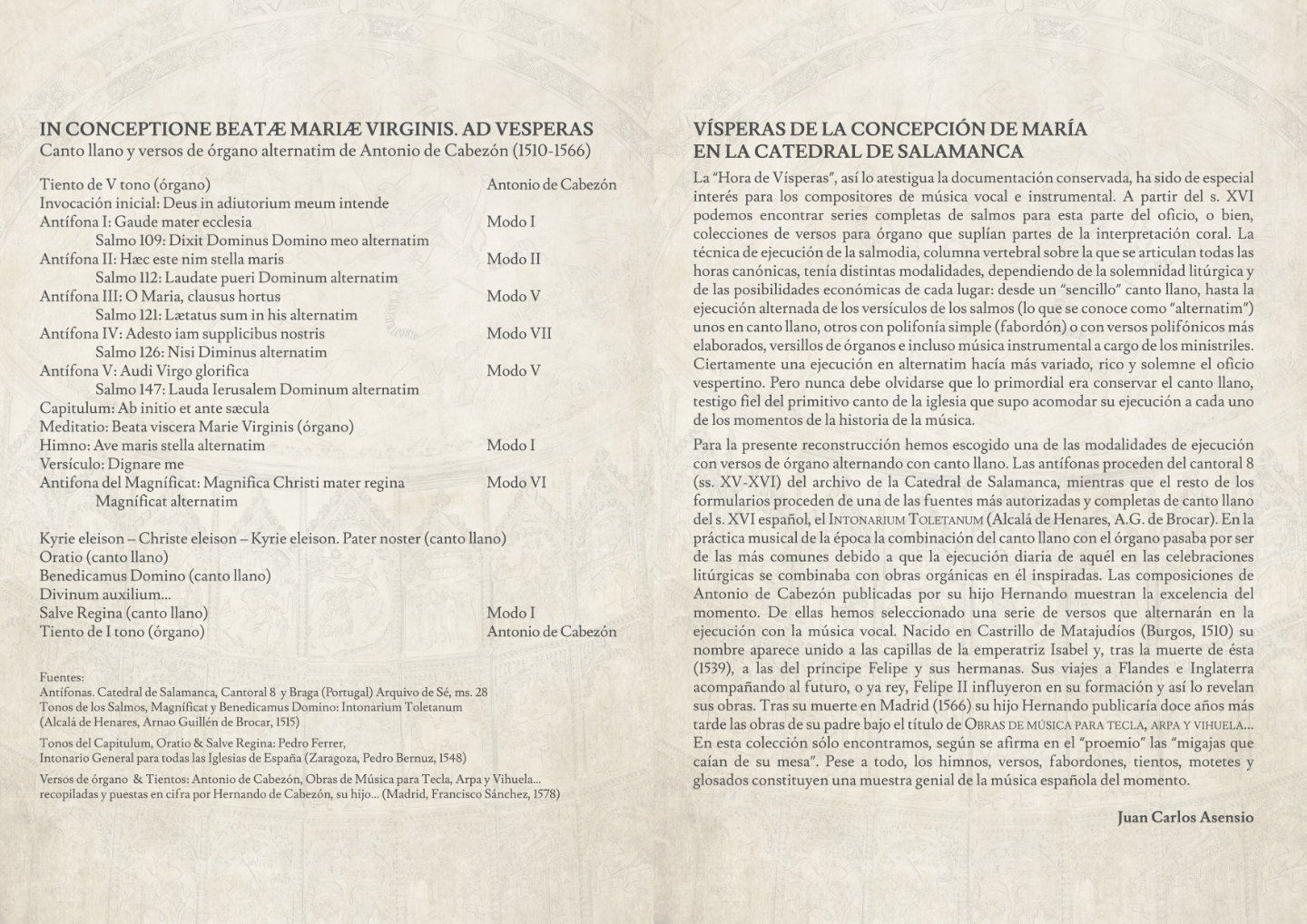
In fulfilment of the Task 2.3 objective to perform and record at least 20 novel medieval chants discovered during the digitization and cataloguing of the Solesmes archive, AHECG (which performs under the name “Schola Antiqua”) under the direction of Juan Carlos Asensio Palacios performed and recorded a program of 13 pieces at the Cathedral of Salamanca. The program, titled “Forgotten Medieval Treasures: The REPERTORIUM Project,” represents world premiere recordings of chants that had been forgotten following the liturgical standardization of the Council of Trent (1545-1563) and had remained dormant in manuscript pages for over 450 years.
Schola Antiqua comprises 16 singers:
- Javier Blasco Blanco
- Miguel Ángel Fernández González*
- Mario Fernández-Pacheco de la Torre
- Javier de la Fuente Jarillo
- Román García-Miguel Gallego*
- Jorge Luis Gómez Ríos
- Daniel Gómez Ruiz
- Antonio Miguel Jiménez Serrano
- Luis Fernando Loro Rodríguez
- José Manuel Martín-Delgado Sánchez
- Abraham Molero López
- Manuel Núñez Llama
- Benigno Antonio Rodríguez García
- Jesús María Román Ruiz del Moral
- Federico Rubio García
- Luis Miguel Salinas Cámara
(*Soloists in the Farced Epistle)
Juan Carlos Asensio Palacios
- Location: Cathedral of Salamanca, Spain
- Transcription and Revision: Dominique Crochu (MMMO) and Juan Carlos Asensio Palacios (AHECG)
- Status: World premiere recordings
- Historical Context: Possibly the first public performances since the Council of Trent’s liturgical standardization
The 13 pieces span diverse liturgical functions and musical genres, arranged according to a “liturgical logic” though not necessarily related to each other in liturgical time:
AD PROCESSIONEM (Processional)
1. Digna cælo Cilinia – Hymn, Mode I
- For the feast of Saint Cilinia, a local saint
ANTE MISSAM (Before Mass)
2. Domine in flagellis tuis – Antiphon, Mode VII-VIII 3. Dixit Dominus ad Adam – Responsory, Mode VII
AD MISSAM (For Mass)
4. Christicolae laudum modulos – Os iusti – Troped Introit, Mode VI
- Grand trope to the introit Os iusti, showing embellishment that solemnized entrance processions in local liturgies
- Associated with Saint Aredius (Saint-Yrieix), well-known from the famous gradual-troparion-prosarium manuscript (F-Pn lat. 903)
5. Kyrie – Ad laudem summæ Trinitatis – Troped Kyrie (Old Roman repertoire), Mode VIII
- Contains melodic references to the Kyrie Orbis factor trope
6. Hodie tam sacra sollemnia – Farced Epistle, Mode I
- An exceptional reading of great length alternating biblical text with commentaries
- Based on Acts 6:8 and following (the stoning of Saint Stephen)
- Alternates between Reader (narrating scripture) and Cantor (interpolating commentary)
- Commentary not only clarifies context but rebukes those who stoned the deacon Stephen
- Contains numerous melodic references to other pieces:
- Secutus desiderabilem references the sequence Laurenti David for Saint Lawrence
- Ut curaret facinora from the sequence Gloriosa dies for Saint Stephen
- Populi fera turba from the trope Benedicamus Domino from Lauds of the feast
- Alienus et immunis from the sequence Congaudentes exsultemus for Saint Nicholas
- Mundo cordis quem soli from Notker Balbulus’s sequence Sancti Spiritus adsit nobis gratia (originally for Pentecost)
- Cassam putantes from the Epiphany sequence Festa Christi omnis
- Neque vindictam from the antiphon Ne reminiscaris Domine
- Demonstrates the extensive knowledge and oral tradition of medieval composers
7. Alleluia. Gloriosus apparuisti – Alleluia, Mode I
- For the feast of Saint Stephen
8. Exsultent agmina (De captione Jerusalem) – Sequence, Mode VII-VIII
- A true historical account of the capture of Jerusalem on 15 July 1099 during the First Crusade
- Functions as both liturgical composition and historical chronicle
- Provides a magnificent geography lesson of the Holy Land
- Rare example of contemporary events commemorated in liturgical chant
9. Alleluia. Deus a Libano veniet – Alleluia, Mode II
10. Munere Christe tuo – Posuisti Domine – Troped Offertory, Mode VIII
11. Propitius esto Domine peccatis – Communion (Old Roman repertoire), Mode I
EXORDIUM
12. Alleluia. Delectatio bona – Responsory, Mode VII
13. Christus resurgens (℣ a dos voces) – Responsory with polyphonic verse, Mode I
- Easter Day responsory
- Verse Dicant nunc Judæi conceived for two voices in almost strict contrary motion
- One of the earliest examples of two-voice organum
- Demonstrates incipient polyphonic practice in liturgical music
Manuscript Sources
The chants were transcribed from 11 different medieval manuscripts spanning the 11th-13th centuries, representing diverse European traditions:
- Graduale from Provins (Bibliothèque Alain-Peyrefitte F-PR ms 13) – 13th century
- Antiphonarium from Worcester Cathedral (GB-WO ms 160) – 12th-13th century (ca. 1230)
- Graduale from Saint-Yrieix (Paris, BnF lat. 903) – 11th century
- Famous gradual-troparion-prosarium associated with Saint Aredius
- Graduale from Santa Cecilia in Trastevere, Rome (Cologny-Genève, Foundation Martin Bodmer C74) – 11th century (1071)
- Source for Old Roman repertoire pieces
- Prosarium/Troparium from Laon (F-LA ms. 263) – 12th century (1187)
- Graduale from Narbonne (Paris, BnF lat. 780) – 11th century
- Cantatorium/Sequentiarium from Saint Martial de Limoges (Paris, BnF lat. 1135) – 11th century
- Graduale-Antiphonarium from Nevers (Paris, BnF lat. 1235) – 12th century
- Graduale from San Giovanni in Laterano, Rome (Vatican, BAV Vat. Lat. 5319) – 12th century
- Source for Old Roman repertoire pieces
Many sources originate from regions where Saint Stephen (the protomartyr) was particularly venerated, accounting for the concentration of pieces for this feast. Others reflect very local devotions (Saints Cilinia, Aredius) that would have been unfamiliar outside their specific regions.
Following the Council of Trent (1545-1563), the Catholic Church undertook a major liturgical standardization to address the “superabundance of localisms” that had developed over centuries. The Council took advantage of the printing press (already in use for a century) to produce official editions:
- Breviarium Romanum (1568) for the Divine Office
- Missale Romanum (1570) for the Mass
Only texts and chants appearing in these official editions were authorized for use. Those excluded were no longer sung and became “relegated to oblivion.” The Church did allow churches and monastic orders that could prove practices more than 200 years old to continue their ancient liturgies, but not all institutions could claim this privilege or chose to exercise it.
Gradually, many magnificent chants disappeared from living memory and remained dormant in medieval manuscript pages. The melodic profiles of these recovered pieces, while sharing general characteristics with Gregorian chant, are often quite different from those in current official editions. Notably, two pieces (Kyrie – Ad laudem summæ Trinitatis and Propitius esto Domine peccatis) actually belong to the Old Roman repertoire, representing an even older stratum of Western chant tradition predating Gregorian standardization.
The program showcases several sophisticated medieval genres:
Troped Chants (items 4, 5, 10): Medieval additions of poetic text and/or musical material to existing liturgical chants, representing creative elaboration that solemnized liturgical actions. These embellishments were among the first elements eliminated during post-Tridentine standardization.
Farced Epistle (item 6): An extraordinary genre alternating scriptural reading with extensive musical and textual commentary. The piece Hodie tam sacra sollemnia is exceptional in its length, dramatic structure, and dense network of melodic references to other known pieces, demonstrating how medieval composers worked within a strong oral tradition, relying on memory and shared melodic vocabulary.
Sequences (item 8): Extended melismatic compositions that developed from elaborations of the Alleluia. The sequence Exsultent agmina is particularly remarkable as a contemporaneous account of the First Crusade’s capture of Jerusalem (1099), functioning simultaneously as liturgical music, historical chronicle, and geographical description.
Polyphonic Elements (item 13): The responsory Christus resurgens includes a verse for two voices in contrary motion, representing one of the earliest surviving examples of two-voice organum, a crucial stage in the development of Western polyphony.
Old Roman Chant (items 5, 11): Two pieces preserve the Old Roman repertoire, an archaic Roman liturgical tradition distinct from Gregorian chant, providing rare glimpses into pre-Carolingian liturgical practice.
Transcription and editorial work was undertaken by:
Dominique Crochu – Co-founder of MMMO (Medieval Music Manuscripts Online) and leader of the Solesmes archive digitization in Task 1.2. Crochu brought paleographic expertise in reading diverse regional neumatic notations and knowledge of the broader manuscript context from the digitization project.
Juan Carlos Asensio Palacios – Director of Schola Antiqua and internationally recognized specialist in medieval chant performance practice. Asensio translated paleographic scholarship into performable editions, making interpretative decisions about rhythm, ornamentation, and vocal production appropriate to each manuscript tradition.
Their collaboration ensured accurate interpretation of neumatic notation from French, English, Italian, and Spanish sources, resolution of ambiguities in pitch relationships and rhythmic groupings, appropriate performance practices for each regional tradition, scholarly documentation of editorial decisions, and easy performability while maintaining historical authenticity.